Project walkthrough · Product architecture
Theoria
Theoria is an interactive music-learning platform covering music theory, playing, production, mixing, and mastering. It adapts the learning-system patterns developed for Pathway to a different educational domain.
Product screenshot
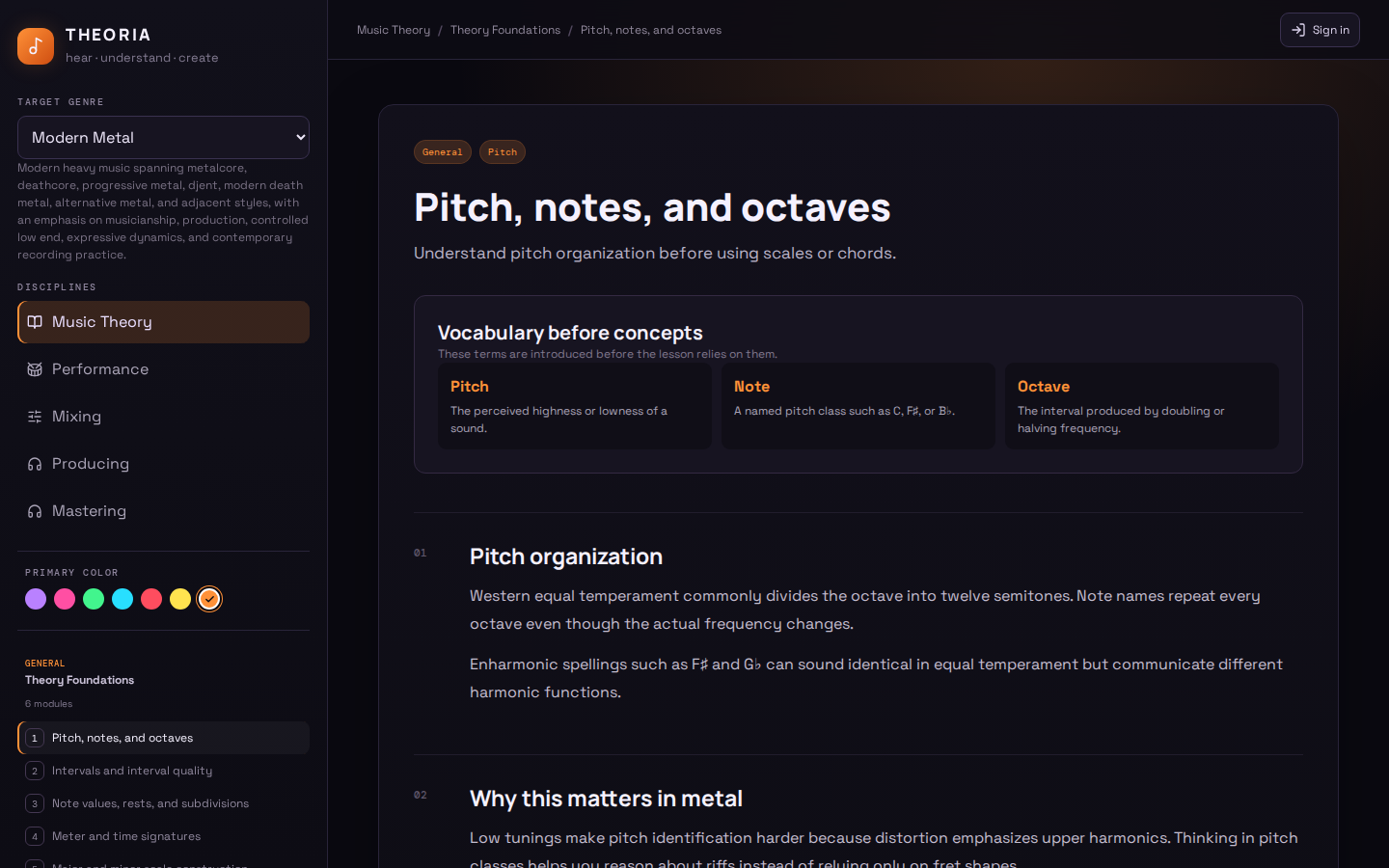
Explore the live site; the screenshot is displayed when the verified public-page capture is available.
The product-design problem
Music-learning content depends on genre, discipline, instrument, and the learner's experience. Rather than creating unrelated lesson pages, the platform models this hierarchy and maintains progress independently of changing genre preferences.
Verified stack
- React 19, TypeScript, Vite and Tailwind CSS for the learning interface.
- .NET 10 minimal API with PostgreSQL persistence through Entity Framework Core.
- Keycloak OIDC and PKCE for identity; browser-local progress permits guest learning.
- Railway-ready configuration for frontend and backend deployment.
Curriculum model
flowchart TD
P[Learner profile] --> G[Target genre preference]
G --> D[Discipline: Theory, Mixing, Producing, Mastering]
D --> C[Course]
C --> L[Lesson and practice exercise]
P --> R[Progress tracking]
This is an illustrative model of the repository's documented curriculum hierarchy, not a database entity-relationship diagram.
Deliberate separation of roadmap and implementation
Current parameter exercises represent real-world audio controls, but the repository explicitly states that they do not process audio yet. The proposed Audio Lab would use Web Audio APIs, AudioWorklet or WebAssembly DSP while retaining lesson and progress identifiers. I distinguish this planned capability from working functionality because architecture communication should accurately reflect delivery state.
Shared patterns, separate products
Theoria reuses architectural and interaction concepts from Pathway while maintaining its own curriculum language. Its documented optional donation mechanism is configuration-based and relies on a separate externally hosted payment page; access to educational material does not require donations.
This case study draws on repository documentation. Additional code-level examples can be incorporated after inspecting the relevant implementation modules.